It's Not Just Farmers Anymore: Pesticides, Parkinson's, and Why Seals Aren't Enough
8 min read

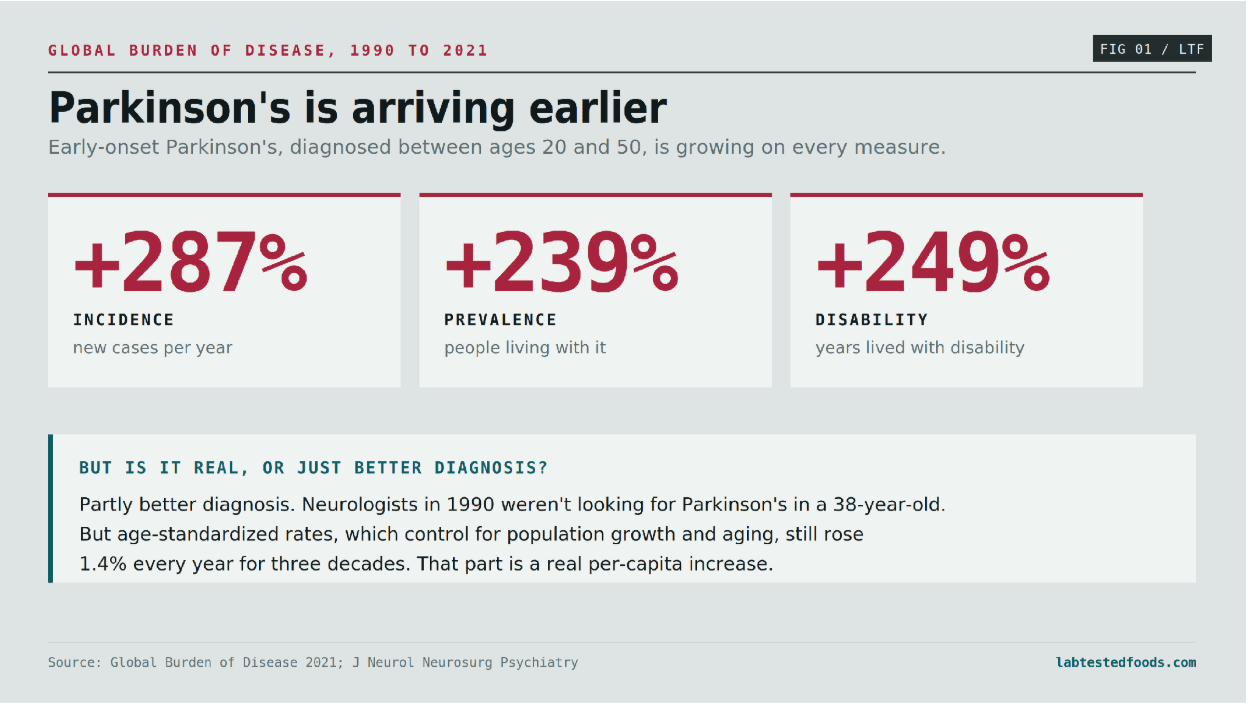
It's Not Just Farmers Anymore: Pesticides, Parkinson's, and Why Seals Aren't Enough Why the certifications on your food and supplements don't answer the question you're actually asking, and what a lab result does instead. Parkinson's used to be a disease of old age. Now that's changing. Global Burden of Disease data shows early-onset Parkinson's, diagnosed between ages 20 and 50, rose 287% in incidence between 1990 and 2021. Some of that is better diagnosis. But age-standardized rates, which control for demographics, still climbed about 1.4% per year for three decades. That's a real increase. The human genome hasn't changed since 1990. The environment has. The strongest environmental signal points at pesticides.
What the research shows Population studies: Long-term residential chlorpyrifos exposure: 2.5x higher Parkinson's risk (UCLA Health, 2026) County-level pesticide use: +36% simazine, +31% atrazine, +25% lindane, all restricted in the EU (Barrow Neurological Institute) Paraquat: banned in roughly 70 countries. Still legal in the U.S. Lab studies explain why. The UCLA work showed chlorpyrifos killing dopamine neurons and disrupting the brain's protein-clearance system, the exact pathology seen in patients. A 2025 study found rotenone left lasting epigenetic changes in the substantia nigra that persisted weeks after exposure ended. Parkinson's doesn't show up the day of exposure. It shows up twenty years later. Which means the exposure that matters to a 35-year-old is happening right now.
The golf course study If this were only a farmworker problem, most people could stop reading. A 2025 JAMA Network Open study closed that exit. Researchers examined 419 Parkinson's cases against 5,113 controls across 139 golf courses in Minnesota and Wisconsin.
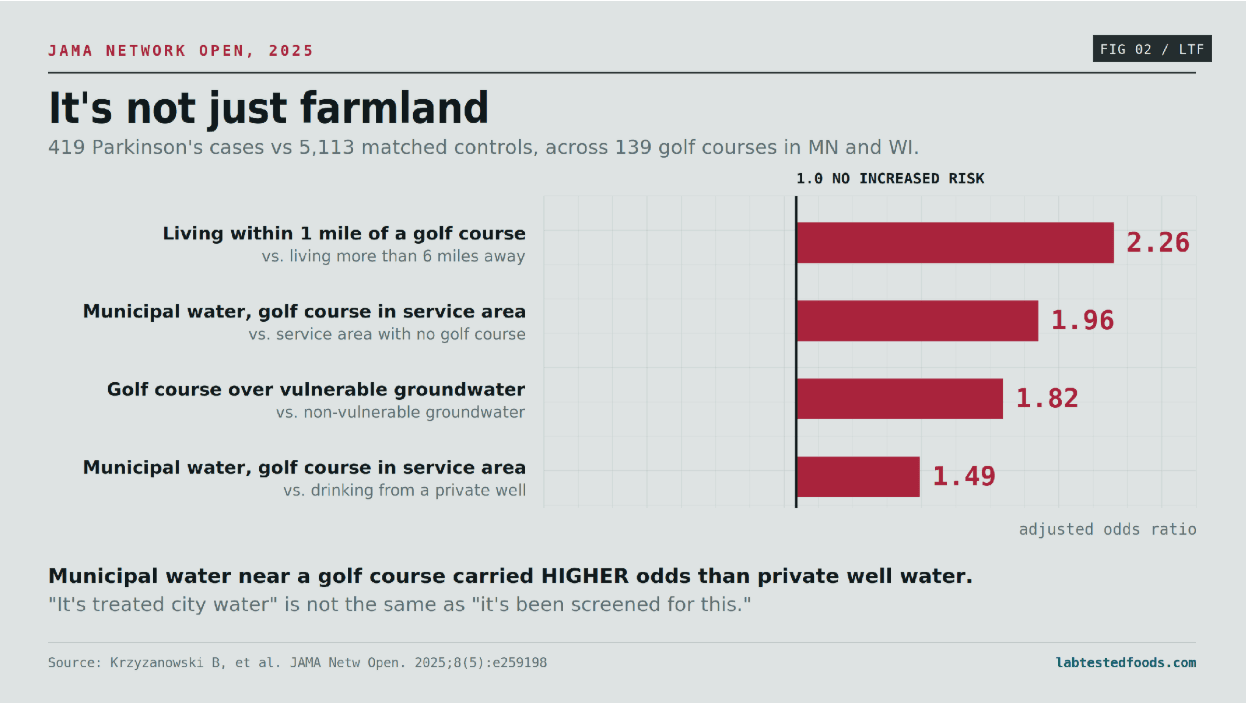
Figure 2. Adjusted odds ratios for Parkinson's disease by proximity and water source. Source: Krzyzanowski B, et al. JAMA Netw Open. 2025;8(5):e259198. Living within 1 mile of a golf course: 126% higher odds of Parkinson's Risk peaked at 1 to 3 miles and declined with distance, a dose-response gradient U.S. golf courses receive up to 15x more pesticide than European ones Then the finding that should change how you think about water: People on municipal water in a service area containing a golf course had nearly double the odds of Parkinson's, and 49% higher odds than people drinking from private wells. Municipal treatment targets pathogens and a defined list of regulated contaminants. It is not a promise that every turf chemical in the local groundwater was screened for. Nobody in that study was spraying anything. They lived nearby and drank the water.
The good news: exposure is not destiny Your pesticide body burden isn't fixed. It tracks what you consume, and it moves fast. In a U.S. diet intervention study, switching to organic produced significant drops across thirteen pesticide metabolites:
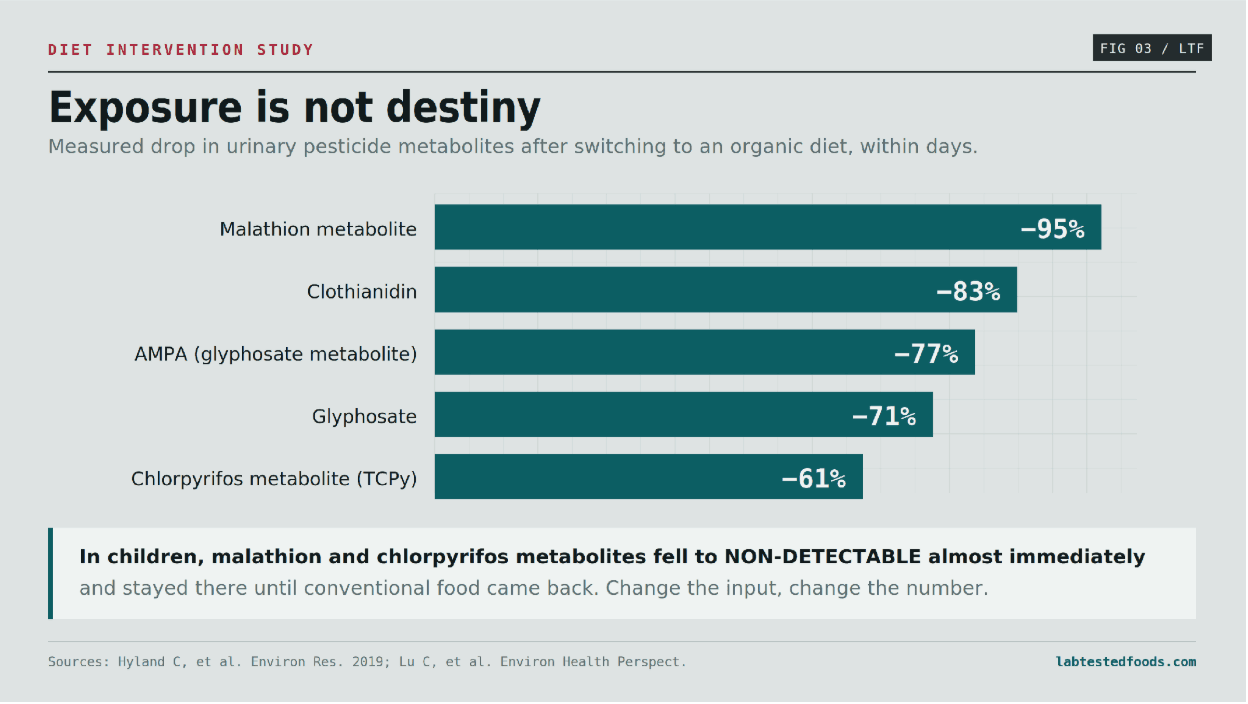
In children, malathion and chlorpyrifos metabolites hit non-detectable within days. Not years. Days. Exposure is an input variable. Change the input, change the number.
So what do the seals actually tell you? Here's where it gets frustrating. Walk down any aisle and you'll see a wall of certifications. Almost none of them answer the question you're asking.
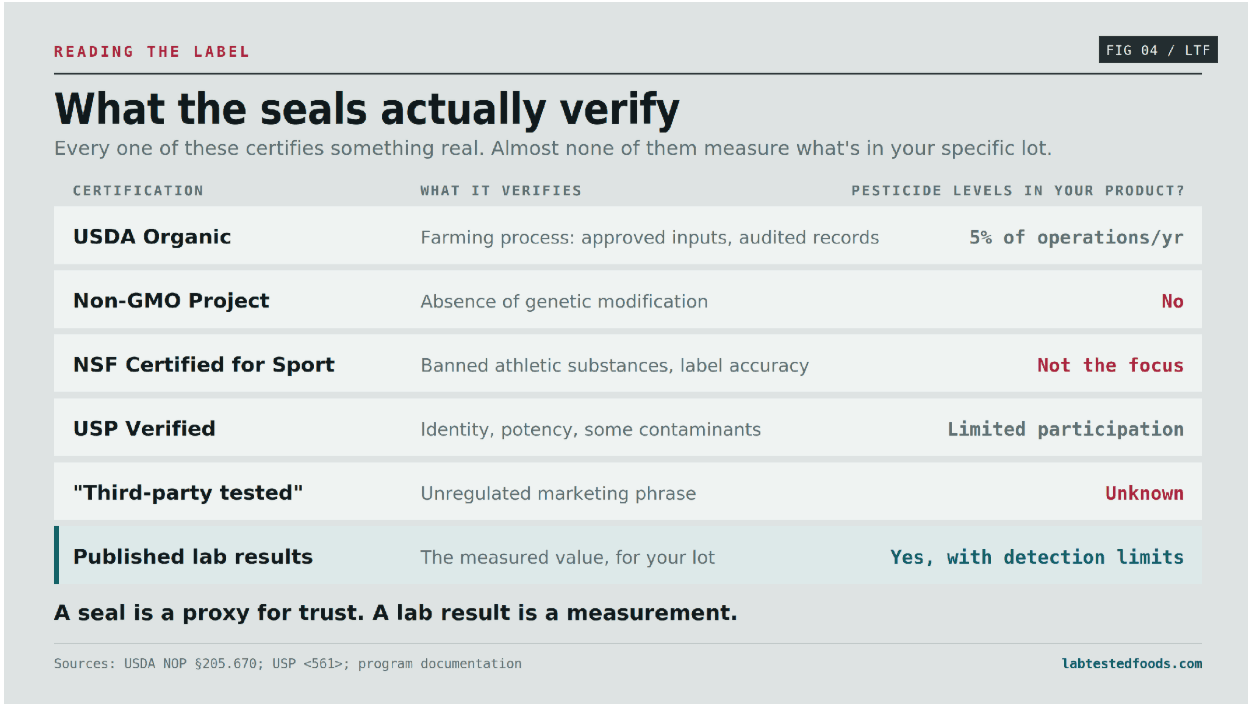
Figure 4. What common certifications verify, and whether they measure pesticide levels in your specific product. USDA Organic is the one most people trust most, so it deserves the closest look. Organic certification is a farming methods audit, not a product test. On residue testing, certifying agents must test at least 5% of the operations they certify each year. Not 5% of products. Not 5% of lots. Operations.
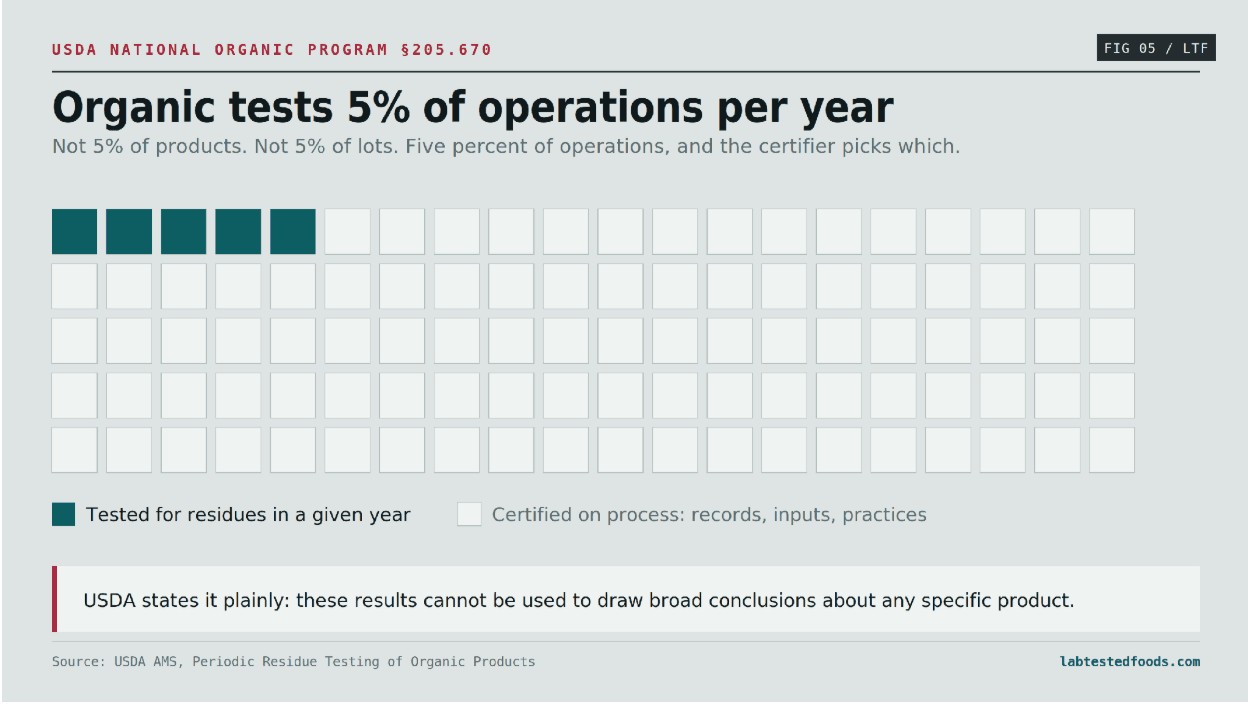
Figure 5. USDA National Organic Program residue testing requirement. Source: USDA AMS, Periodic Residue Testing of Organic Products. USDA says so plainly: because selection and test panels vary so much, results cannot be used to draw broad conclusions about any specific commodity or product. And organic can't prevent drift from neighboring farms, legacy soil contamination, or contaminated irrigation water. Organic is a strong prior. The biomonitoring data proves it works. But a prior is a probability statement about a category. It is not a measurement of your product. Organic is also expensive and slow, and that's a problem Here's the part that gets left out of the conversation. To sell as certified organic, land must be managed organically for 36 continuous months before the first certified harvest. During that window, a farmer follows every organic rule, absorbs yield drops of roughly 30% while soil biology rebuilds, and still can't charge organic prices. Certification fees run a few hundred to several thousand dollars a year. Cost-share programs reimburse up to 75%, capped. Annual inspections continue indefinitely. The fee isn't the barrier. The three-year cash-flow gap is. The result: plenty of small, honest producers grow clean product they cannot legally call organic. And plenty of large companies buy the seal, then coast on it. The seal became a proxy for trust. It was never a measurement. What lab testing does that no seal does Lab testing skips the proxy and measures the thing. GC-MS/MS catches organochlorines, organophosphates, and pyrethroids. LC-MS/MS catches neonicotinoids and modern herbicides. Comprehensive screening needs both. A lab using one technique systematically misses entire chemical classes. That's not a philosophical claim about farming practice. It's a number, for a specific lot, for the product in your hand.
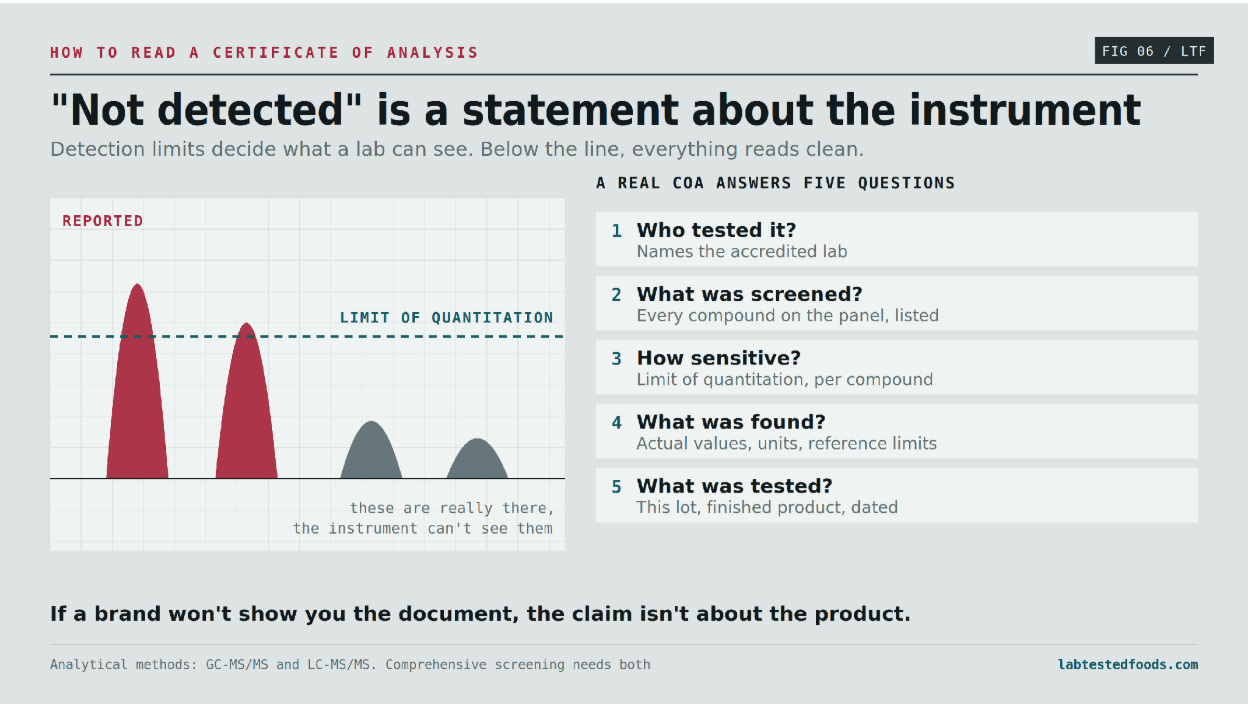
Figure 6. Detection limits determine what a laboratory can report. A result of “not detected” is bounded by the limit of quantitation. It matters most for supplements, which are the widest gap in the market. Botanicals are crops, grown outdoors, often overseas, dried in open air. And here's what almost no consumer knows: extraction can concentrate pesticides. A 10:1 extract concentrates the actives you want, and can concentrate co-extracted residues right along with them.
Then consider that you take supplements every morning, for years. Concentration times frequency times duration. Supplements can score high on all three at once.
Standards exist. USP <561> sets residue limits for botanicals. But testing is largely the manufacturer's judgment call: they decide whether to test, what panel to run, and whether to show anyone the results. Most supplements aren't contaminated. But for most, nobody looked. And “nobody looked” gets marketed in the same confident language as “we looked hard and found nothing.”
What we're building at Lab Tested Foods This is why Lab Tested Foods exists. We're not adding another seal to the wall. We're publishing the underlying data: third-party lab results, per product, so you can see what was screened, what was found, and at what detection limit. Our standard rests on three principles: Show the numbers. Not a badge. The actual certificate of analysis: the lab, the panel, the limit of quantitation, the values, the lot. Testing is accessible in a way certification isn't. A small producer can't wait three years and eat a 30% yield drop. They can test a lot. This gives honest brands a way to prove quality now, and it removes the excuse from brands who can afford testing and choose silence. Absence of evidence isn't evidence of absence. “Not detected” means nothing without a detection limit. “Tested” means nothing without a panel. We publish both. Accountability isn't asking companies to make claims. It's asking them to show their work. See the results for yourself at labtestedfoods.com.
The honest bottom line Nobody can tell you that testing your food, supplements, and water prevents Parkinson's. Anyone who says that is misrepresenting the science, and that misrepresentation gives reasonable people permission to dismiss evidence that deserves to be taken seriously.
What's defensible: Pesticide exposure is associated with elevated Parkinson's risk, with dose-response gradients and a demonstrated mechanism exposure isn't limited to farmwork. It reaches ordinary neighborhoods through groundwater, drift, food, and supplements exposure is measurable, and it drops fast when inputs change Early-onset cases are rising faster than demographics explain current systems verify process and legality. They don't characterize what's in your product, and were never built to reducing an exposure with a credible link to an irreversible neurodegenerative disease, at essentially no cost to your life, isn't paranoia. It's a seatbelt. You're not predicting a crash. You're declining to leave a controllable variable uncontrolled.
Testing turns an assumption into a number. Twenty years from now, the number is what you'll wish you'd had.
Sources Krzyzanowski B, et al. Proximity to golf courses and risk of Parkinson disease. JAMA Network Open. 2025;8(5):e259198. UCLA Health / Molecular Neurodegeneration, 2026. Residential chlorpyrifos exposure and Parkinson's risk. American Parkinson Disease Association. Rotenone exposure and epigenetic changes in the substantia nigra. American Parkinson Disease Association. Paraquat and Parkinson's disease. Barrow Neurological Institute. Simazine, atrazine, and lindane county-level exposure analysis. Global Burden of Disease Study 2021. Early-onset Parkinson's incidence and prevalence trends. Hyland C, et al. Organic diet intervention significantly reduces urinary pesticide levels. Environmental Research. 2019. Lu C, et al. Organic diets significantly lower children's dietary exposure to organophosphorus pesticides. Environmental Health Perspectives. USDA Agricultural Marketing Service. National Organic Program, Periodic Residue Testing (7 CFR 205.670). USDA. Organic 101: Strengthening Organic Integrity through Increased Residue Testing. USDA Agricultural Marketing Service. Transitioning to Organic Certification. Journal of Environmental Science and Health. Pesticide residues in dietary supplements. United States Pharmacopeia, General Chapter <561>. Articles of Botanical Origin.